Brook trout
Salvelinus fontinalis
What it is, and why it matters
The brook trout is not a trout.
Salvelinus fontinalis is a char, the same genus as lake trout and Arctic char, and a different genus from every other fish in this challenge. The other four are Oncorhynchus or Salmo. That is not a technicality. It is why brook trout cannot hybridize with cutthroat, and why the harm they do here is competition and predation rather than genetic dilution. It is also why they are the easiest fish on this list to identify.
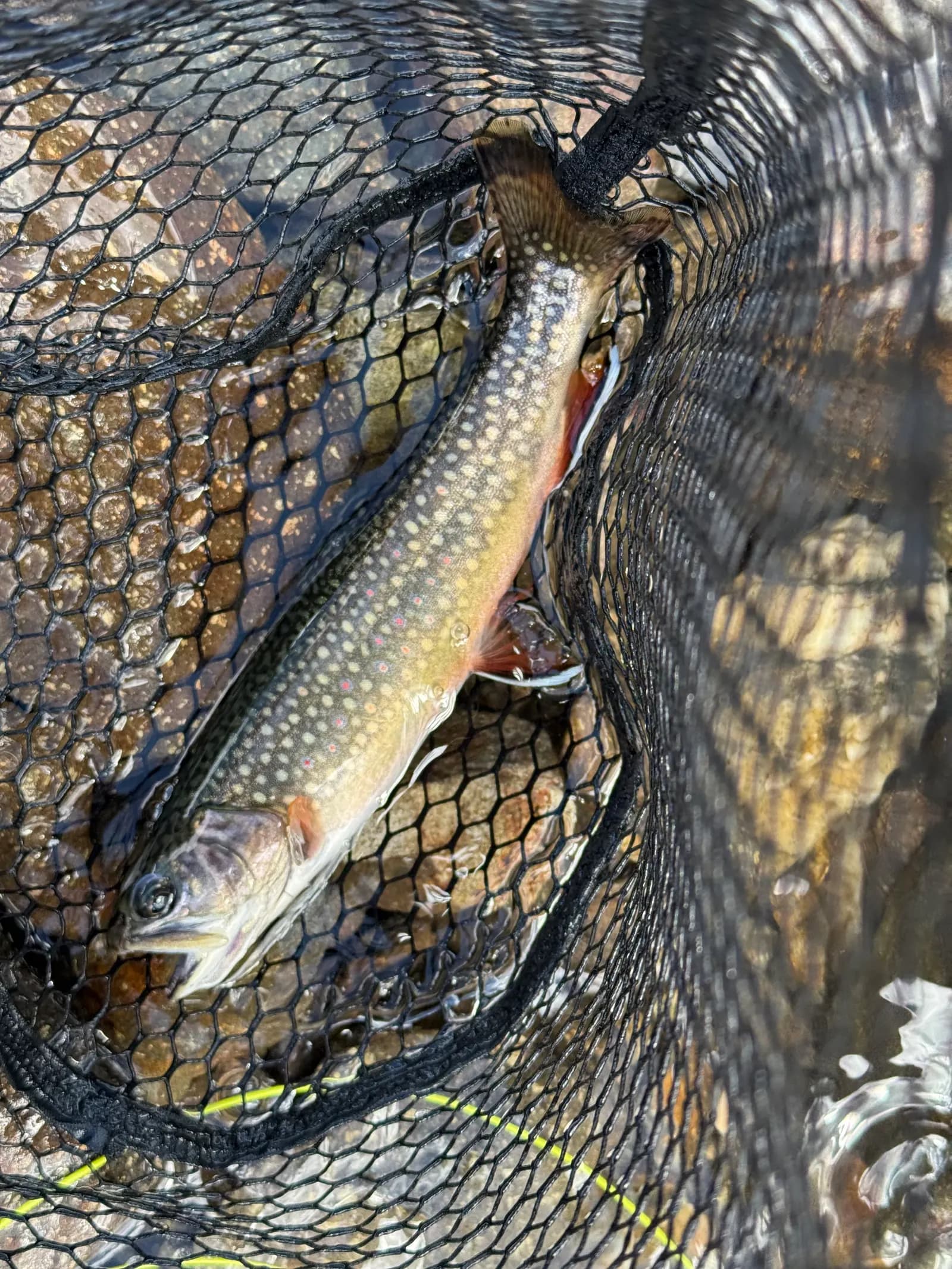
They are, by fairly broad agreement, the most beautiful fish in these mountains. Olive backs marked with dark wavy lines like worm tracks. Red spots ringed in pale blue. A white leading edge on the lower fins that looks painted on. In fall the flanks go orange-red.
And in a specific named list of conservation streams, New Mexico would like you to keep them.
Brook trout came to New Mexico's high country from the southern Appalachians in the late 1800s, stocked partly to replace native cutthroat that heavy harvest had already thinned. They thrived, and they did it in exactly the cold headwater streams the cutthroat had retreated into. They take food and space, they eat cutthroat eggs and fry, and cutthroat do not return the favor, probably because they did not evolve eating fish. Where the two overlap, brook trout generally win.
So the bag limit comes off in a short, bounded, well-marked list of waters. Everywhere else in the state they are an ordinary game fish under ordinary limits, and a well-regarded one.
None of which is the brook trout's fault. People moved this fish, on purpose, to solve a problem people had made. In its own range in the eastern United States it is the imperiled native, pushed out of its water by introduced rainbows and browns. Same story, opposite roles, different watershed.
Worth holding onto while you hold the fish.
Identifying it
The easiest identification in the challenge. Three marks, any one of them sufficient, all three photograph well.
Feature | Brook trout |
|---|---|
Vermiculations | Dark, wavy, worm-track lines across the back and dorsal fin. No other New Mexico salmonid has them. |
Spot polarity | Light spots on a dark background. Every true trout here is dark spots on light. Char reverse it. |
Fin edges | A bright white leading edge on the pelvic, anal and pectoral fins, backed by a narrow black stripe. |
Sides | Red spots ringed with pale blue halos. |
Body | Olive to dark; orange-red flanks in fall. |
Tail | Squarish. The old nickname is squaretail. |
The second mark is the taxonomy stated as a visual: char reverse the pattern. Notice it once and you will not mistake a brook trout again.
White fin edges are not white fin tips
Different marks, different meanings, and they get conflated constantly.
Brook trout: a continuous white stripe the length of the leading edge, black stripe behind it.
Rainbow and cutbow: a small pale tip, no black stripe. On a fish with a red slash, a white tip suggests rainbow ancestry.
Brook trout and brown trout are the only two fish here with red spots in pale halos. The separation is instant: brook trout have vermiculations and light-on-dark spots, brown trout have neither, plus a square tail and a jaw that runs past the eye.
A mouth-based check separates char from trout by the arrangement of teeth on the roof of the mouth. Do not go looking for it. It means handling a fish that is probably going back, and the three external marks settle the question from a photograph.
For your challenge photo
Get the back and the flank in frame together. The vermiculations are the clearest confirmation a reviewer can get, and a straight side-on shot at water level can flatten them out of view. A slight angle showing the top of the back works better here than for any other species on the list.
Range and status in New Mexico
High-elevation streams and lakes in the northern mountains, generally above about 9,000 feet.
NMDOW's own characterization will surprise people: brook trout are "relatively uncommon in New Mexico and typically found in smaller, less accessible streams."
They are not overrunning the state. They are concentrated in precisely the small, cold, high headwaters that are the last refuge of the Rio Grande cutthroat. Locally abundant, in exactly the wrong places. That is a more useful picture than "invasive species spreading across the state," which is neither accurate nor the department's own word.
Status: not native, not listed, no conservation status, no special permit, no closed season. A fully legal game fish.
NMDOW publishes no typical size for New Mexico brook trout, and out-of-state figures describe different fish in different water. The New Mexico answer is more interesting anyway: brook trout overpopulate and stunt in the small streams they occupy here. A creek full of six-inch brook trout is a common outcome, and it is a worse fishery than the same creek holding cutthroat, which do not stunt that way and reach at least the size of other trout in the same water.
That moves the harvest argument from duty to self-interest, and it happens to be true.
Management in New Mexico
On this page, restoration means removal.
Why they win. Three mechanisms, in descending order of how well they are sourced.
Competition for food. NMDOW states this directly.
Predation on eggs and fry. This is what separates brook trout from brown trout, which the New Mexico evidence indicates do not prey on cutthroat at any life stage. Brook trout do, and they remain predacious on eggs and fry even when stunted by their own overpopulation.
Habitat. Researchers have found displacement severity tracking water temperature, fine sediment, and the abundance of pools and woody debris.
What removal looks like. The bag limit comes off brook trout, rainbow and brown together in a named set of conservation streams. Above barriers, agencies use mechanical removal. The recovery sequence is the same as for the natives generally: clear the nonnatives, install a barrier, repatriate pure native fish.
Does keeping a few actually matter?
At the scale of a whole watershed, angler harvest alone will not eradicate an established brook trout population. It will not. Agencies use barriers, mechanical removal and in some places genetic techniques, because that is what the job requires. Anyone who tells you your creel saves a species is flattering you.
What angler harvest does is reduce competition and buy time above a barrier where a cutthroat population is being re-established. That is specific, real, and worth doing.
New Mexico has been evaluating a genetic approach to brook trout control with university and federal partners. The details are not published here; the primary source could not be retrieved.
A wildfire in 2011 cleared a stream of nonnative brook trout, and the recovery team took the opening and restocked Rio Grande cutthroat there. A catastrophic fire did what a removal project would have done. That is not a strategy. It is what working on the margin looks like.
The unlimited bag and the tackle restriction are one rule
The conservation waters where the brook trout limit is removed also require artificial fly or lure with a single barbless hook.
Filling a creel with brook trout on bait in one of those streams is a violation, committed by someone who believes they are helping.
Check the consumption advisories before you eat them
New Mexico publishes mercury advisories by water and by species, and at least one lake holding brook trout carries one.
The tables are per-water and they change. Get them from the rules booklet, or from the New Mexico Environment Department's Surface Water Quality Bureau.
The spawn. Brook trout spawn in fall, later than browns, from late October into December, and they are obligate groundwater spawners: the redd goes over an upwelling spring or at the tail of a pool. New Mexico protects none of it. Clean, light-colored gravel is a redd. Walk around it.
Handling this fish, and when not to fish for it
Most of what follows is about the fish you are not keeping. In the conservation waters the state asks you to harvest brook trout, and there the ethic is a clean, quick dispatch rather than a careful release. Everywhere else, which is most of New Mexico, the ordinary ethic applies.
Do not let "nonnative" become a license for careless handling. A fish you are going to release deserves to survive it, whatever its passport.
When not to fish
On the sourcing
New Mexico publishes no water-temperature angling guidance. The thresholds below are other states' agencies, labeled as such.
Condition | Guidance | Whose |
|---|---|---|
65°F | Harvest legal limits rather than practice catch-and-release | WGFD |
68°F | Our line for catch-and-release. Stop. | this site |
70°F+ | Stop catch-and-release entirely for the day | WGFD |
Above 75°F | Hazardous; above 80°F often fatal | WGFD |
Over a redd, in fall | Do not wade there, at any temperature | this site, on Roberts & White 1992 |
Brook trout are the least heat-tolerant of the five, which matters because they live in the water anglers assume is automatically cold. Two state agencies give different preferred bands, one about 53°F or less, another 50–65°F. They agree on the ranking.
Elevation is not a thermometer
A stream at roughly 7,900 feet in the upper Pecos read 73.9°F in early August 2026.
Going up is not a substitute for measuring. Carry a thermometer.
How to handle it
Steps 1 through 8 are NMDOW's own published Catch and Release Tips, 2026–2027 rules booklet, p. 21.
- Land the fish quickly and don't play it to exhaustion.
- Use a landing net whenever possible.
- Keep the fish in the water.
- Do not squeeze or grab any part of the fish. Wet your hands first if you must handle the fish.
- Gently remove the hook.
- If the hook is swallowed deeply, cut the leader.
- Let a tired fish recover. Hold it by the tail in the water, supported from below, until it swims away.
- Never toss or throw a fish back into the water.
The law does not require the following. We are asking you to. Pinch your barbs, which the conservation waters require anyway. Keep air exposure to a few seconds. Never lift a fish by the jaw or hold it vertically; these are small, light-boned fish. Wet everything the fish touches.
If you are keeping them, dispatch them promptly and use them. A fish taken under a conservation rule and then wasted has not served the purpose the rule exists for. Keeping brook trout is a legitimate contribution. Leaving them on the bank is littering.
Your challenge photo
Back and flank in frame together, so the vermiculations show. Camera ready before the fish is, shot over the water or the net, one or two frames.
What the law requires
Read the current rules for the water you are standing in
Bag limits, permits, seasons and tackle restrictions are per-water and change annually.
Structure verified against NMDOW's 2026–2027 New Mexico Fishing Rules & Info on 2026-08-04. Figures deliberately not reproduced here.
No special permit exists for brook trout, and there is no closed season anywhere in New Mexico. Standard license, validations and stamps. Stamps are required on Forest Service and Bureau of Land Management land, which covers nearly all of this fish's New Mexico range.
In a named set of conservation waters the bag limit on brook trout is removed entirely. The rule reads "bag limit unlimited for rainbow trout, brown trout and brook trout." Those same waters require artificial fly or lure with a single, barbless hook.
The mirror image, and this is the one that catches people
In the other Special Trout Waters, everything is catch-and-release including brook trout.
An angler who reads a "keep every brookie" article and applies it in the wrong reach is breaking the law while trying to help. The unlimited-harvest waters are a specific named list. They are not "the high country."
Chumming and baitfish are prohibited in every Special Trout Water.
Stocking fish anywhere in New Mexico without a permit is illegal, as is transporting live game fish away from the water where they were caught. The reason brook trout are in these headwaters at all is that people moved them, and moving them is now a crime.
Consumption advisories exist by water and by species.
What the law does not require
Nothing requires you to keep a single brook trout. New Mexico encourages harvest by removing the limit. It never mandates it. The only mandatory-kill rule in the state applies to northern pike at one lake. If anyone tells you New Mexico requires you to kill brook trout, they are wrong.
There is no spawning protection. Brook trout spawn in fall over upwelling groundwater and no rule protects those redds.
No temperature rule exists.
Nothing requires you to pinch a barb outside the waters that specify it.
Sources
19 references10 first-party
Char, *Salvelinus*; vermiculations; light spots on dark; blue halos; white fin margins; "squaretail"; least heat-tolerant
Worm-like lines; white leading edges; opportunistic diet; 50–65°F band
"Relatively uncommon in New Mexico and typically found in smaller, less accessible streams"; conservation-water bag removal and tackle restriction; catch-and-release in other Special Trout Waters; consumption advisories
NMDOW, 2026–2027 Fishing Rules & Info, pp. 10, 16, 18, 20, 22, 40–44
The eight-point release list
No mandatory-harvest rule for brook trout anywhere in New Mexico
No spawning protection and no temperature guidance
Brook trout compete with cutthroat for food
Predation on cutthroat eggs and fry; overpopulation and stunting; cutthroat do not stunt the same way
Arnold Atkins, Truchas Chapter of Trout Unlimited, 2026-01-15
Displacement severity tracks temperature, fine sediment, pools and woody debris
Research summary
Brown trout, by contrast, show no evidence of predation on cutthroat at any life stage
New Mexico State University study (Lauren Flynn, MS), via New Mexico Trout
Stock from the southern Appalachians; introduction soon after the 1896 rainbows
A 2011 wildfire cleared a stream of brook trout; cutthroat since restocked
NMDOW
Fall spawning; obligate groundwater spawners; New Mexico timing late October into December
Synthesis across state agency pages and a watershed non-profit; New Mexico timing from a club newsletter
Up to 43% mortality from a single wading over a redd
Roberts & White 1992, NAJFM 12(3)
65 / 70 / 75 / 80°F thresholds
State record
Upper Pecos 73.9°F, August 2026
USGS stream gauge
Typical size in New Mexico: no figure published
NMDOW species and record pages, checked 2026-08-04
The genetic (YY-male) brook trout control program
Primary source not retrievable (HTTP 403)